The GMC Syclone: The Turbocharged Pickup That Humiliated Ferraris and Redefined Performance Trucks
The 1991 GMC Syclone, a turbocharged AWD sleeper truck, outran Ferraris and now fetches six-figure values.
Some pickups are built to haul. Others are built to do it all. Every now and then, one of these machines rolls out of a factory seeking vengeance, and the 1991 GMC Syclone wasn’t content to just be quick for a pickup. Oh no. This thing was out to prove it was quick, period—the kind of quick that leaves sports cars scrambling to catch up and their drivers utterly embarrassed. Back in the early ’90s, when muscle cars were chunky and exotics were out of reach, GMC flipped the script with a turbocharged, all-wheel-drive superstar that didn’t need flashy graphics or billboard stripes to make its point. It was the ultimate sleeper, and it left a mark so deep that even today, gearheads still talk about it in hushed, reverent tones.
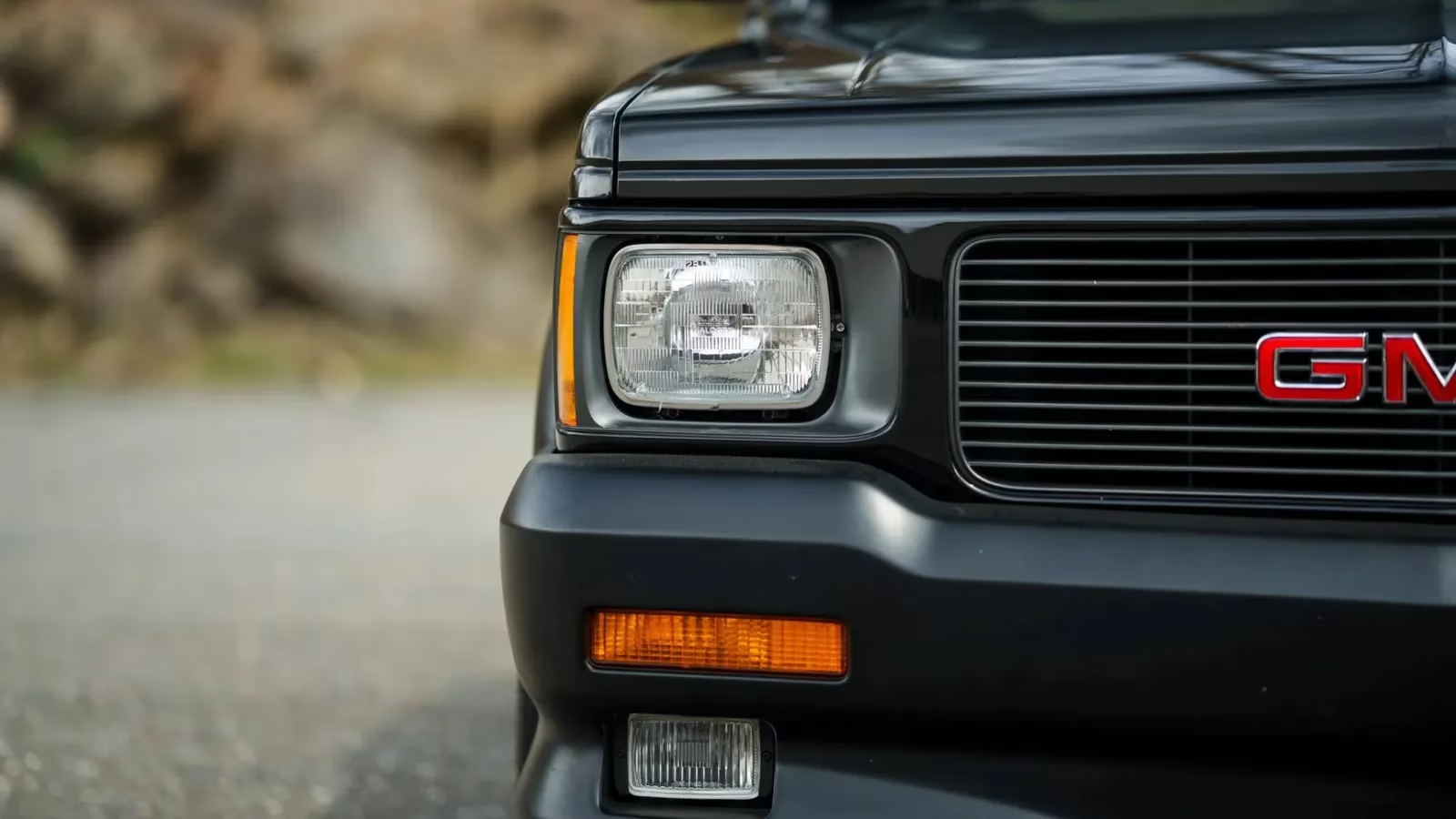
Slap a turbocharged 4.3-liter LB4 V6 into a compact Sonoma pickup, mate it to a full-time all-wheel-drive system borrowed from a Safari van, and you’ve got a machine that could genuinely outrun every production car in America to 60 mph. That’s not bench‑racing bluster. When Car and Driver lined it up against the Ferrari 348ts in November 1991, the Syclone didn’t just win—it dusted the Italian exotic in both the quarter‑mile and the 0‑60 sprint. The 1991 C4 Corvette ZR‑1? Same story. With a 0–60 time of just 4.3 seconds and a quarter‑mile pass of 13.4 seconds, the plucky little pickup made the establishment sit up and take notice. In an era stuffed with Camaros, ZR‑1s, and Japanese turbo toys, the Syclone wasn’t playing in the kiddie pool; it was the real deal, a blue‑collar brute that could hang with the big dogs and then drop them like a bad habit.
Nobody at GMC really clocked what the Sonoma could become until Kim Nielsen stepped into the picture. According to enthusiasts’ lore, Nielsen—a true “car guy”—pushed to blend a turbocharged V6, full‑time AWD, and a sport‑tuned suspension. The wild notion found a home with Production Automotive Services (PAS), the Michigan crew behind the Turbo Trans Am, and before anyone knew it, a sleeper storm was rolling toward reality. First unveiled as a concept at the 1989 Detroit Auto Show, the Syclone thundered into production in 1991. GMC and PAS built only 2,995 units (plus three later 1992 models), and making the truck in any color other than black was rarer than hen’s teeth. Under the skin, the Syclone rocked Bilstein shocks, quad‑ABS, and that BorgWarner all‑wheel‑drive setup, making it ready to race right out of the gate—no garage‑tuner heroics required.
Back in ’91, you could slide behind the wheel of this elusive machine for about $25,970, roughly five grand more than a Corvette Z28. That was a spicy meatball at the time, but fast forward to 2026 and the sticker shock works the other way. According to market watchers, a well‑maintained Syclone now commands anywhere from $50,000 to $70,000, with concours‑grade garage queens nudging the $200,000 mark. Production numbers were microscopic, so it’s a seller’s game. Values have been climbing steadily as a new generation of collectors wakes up to the fact that a pickup with this kind of pedigree is anything but ordinary.
Recent auction results prove the point. A black 1991 Syclone with a mere 25,000 miles on the odometer and still in its original state fetched $44,000; a few years later, a 380‑mile time capsule—essentially a new truck—brought a jaw‑dropping $130,000. In 2026, you can bet those numbers are viewed as entry level for a serious piece of automotive history. The Syclone may have kicked the doors open, but it didn’t stay alone for long. Over the years, a few other bold machines lined up at the start line to prove that a truck bed and big quarter‑mile times aren’t mutually exclusive.
Ford’s SVT crew answered the call in the 1990s with the first‑gen F‑150 Lightning. They took a workhorse platform and injected a naturally aspirated 5.8‑liter Triton V8 that pumped out 360 hp and 440 lb‑ft of twist. Dropped on a lowered suspension with Bilstein shocks and a dual exhaust, the Lightning wasn’t exactly a supercar killer, but it could hustle: 0–60 mph in about 7.2 seconds and the quarter‑mile in 15.6 seconds at 87 mph. In an era when trucks were expected to be slow‑pokes, that was a genuine shock. Ford only churned out around 8,000 units, making the first Lightning both rare and the godfather of modern performance trucks like the Raptor.
Then came the absolute nutter of the bunch: the Dodge Ram SRT‑10. If you ever wondered what it’d be like to stick a Viper under a truck’s hood, Dodge answered with a vengeance. The 8.3‑liter V10, ripped straight from the slithering sports car, belted out 510 hp and 535 lb‑ft of torque to the rear wheels through a Tremec six‑speed manual (or a four‑speed auto in Quad Cab guise). The numbers on the asphalt were simply rude: 0–60 mph in 4.9 seconds, a 13.6‑second quarter‑mile at over 105 mph, and a Guinness World Record in 2004 as the “World’s Fastest Production Pickup Truck” with a top speed of 154.6 mph. With just over 10,000 built, the SRT‑10 became an instant cult hero, a truck that wasn’t just playing on the drag strip—it was owning it.
At the end of the day, none of these machines were supposed to exist. A turbo V6 in a mini‑truck? A Viper-powered Ram? A street‑tuned F‑150? They were built by engineers and gearheads who refused to color inside the lines. Decades later, the 1991 GMC Syclone remains the high‑water mark, a pickup that didn’t just haul cargo—it hauled history. Whether it’s silently stalking a freeway on‑ramp or dunking on exotics at a car meet, the Syclone still proves that sometimes, the most dangerous thing on the street is wearing a tailgate.
Comments