I Found a $16,000 Super Sedan That Smokes a Ferrari 456M
The 469-hp supercharged 2003 Mercedes-Benz E55 AMG sedan outruns a Ferrari 456M V12 and is now a used performance bargain.
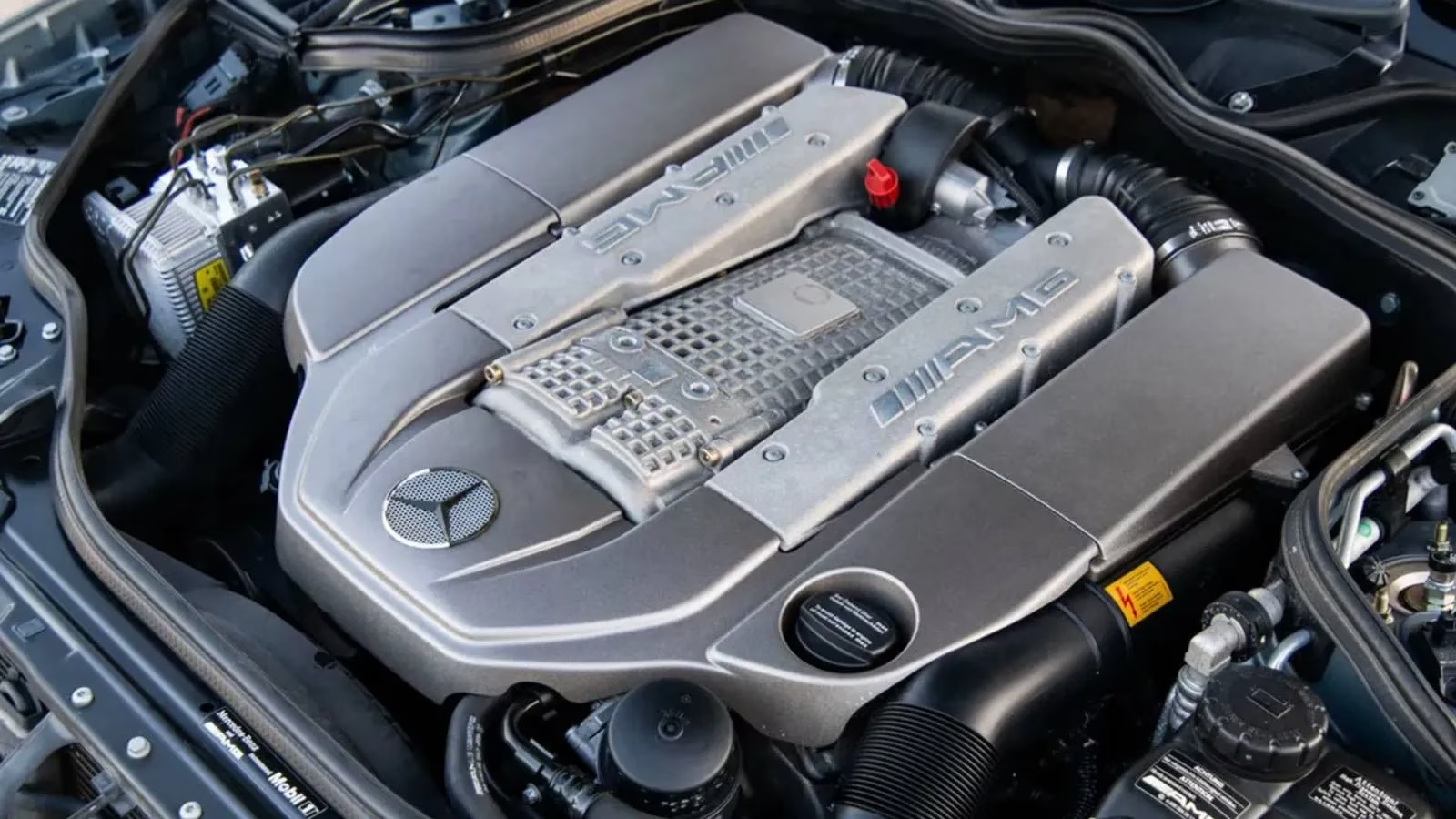
I spend far too much time hunting for forgotten performance gems from the turn of the millennium—cars that deliver modern thrills without the modern price tag. Recently, I stumbled back onto a particular supercharged brute that I believe deserves way more attention in 2026: the W211 Mercedes-Benz E55 AMG. Back in 2003, this unassuming four-door family sedan was annihilating some bona fide exotic cars in straight-line acceleration. And the most shocking part? You can now park one in your driveway for the price of a ten-year-old economy car.
Let’s rewind to the early 2000s, when Ferrari’s front-engined V12 grand tourer, the 456M, was considered a benchmark of effortless speed and luxury. With its Pininfarina lines and a 5.5‑liter naturally aspirated V12 churning out 442 horsepower and 406 lb‑ft of torque, the 456M could hit 60 mph in about 4.8 seconds and keep pulling to a top speed of 192 mph. It was a statement of wealth, style, and performance. But in the real world, a supercharged German sedan was about to humble it at the stoplight.
Mercedes‑AMG’s engineers had stuffed a hand‑built 5.4‑liter supercharged V8, code‑named M113K, under the hood of the humble E‑Class. Output was rated at 469 horsepower and a thunderous 516 lb‑ft of torque—numbers that gave the E55 a 27‑horsepower advantage and a staggering 110 lb‑ft torque surplus over the Ferrari. That supercharged grunt translated directly to the tarmac: 0 to 60 mph came up in just 4.5 seconds, making the E55 AMG demonstrably quicker out of the hole than the prancing horse, whether you opted for the 6‑speed manual Ferrari or the GTA automatic version (4.7 seconds). From a rolling start, the instant punch of forced induction made the Mercedes feel even more urgent.
| Specification | 2003 Mercedes‑Benz E55 AMG | Ferrari 456M |
|---|---|---|
| Engine | 5.4L Supercharged V8 | 5.5L Naturally Aspirated V12 |
| Horsepower | 469 hp | 442 hp |
| Torque | 516 lb‑ft | 406 lb‑ft |
| 0‑60 mph | 4.5 seconds | 4.8 seconds |
| Top Speed | 155 mph (limited, ~200 mph without limiter) | 192 mph |
| Drivetrain | Rear‑wheel drive, 5‑speed automatic | Rear‑wheel drive, 6‑speed manual / 4‑speed auto |
Sure, on an unrestricted autobahn, the Ferrari would eventually walk away thanks to its higher top speed (192 mph versus the E55’s electronically limited 155 mph). But factory insiders have long whispered that with the governor removed, the supercharged E55 would sail past 200 mph. In typical driving conditions—merging onto highways, overtaking on two‑lane roads, or simply pinning the throttle at a green light—the E55’s instant‑shove torque delivery made it the quicker real‑world weapon.
When the E55 AMG debuted for the 2003 model year, it instantly became one of the fastest production sedans on the planet. The supercharger’s broad torque plateau, combined with a quick‑witted five‑speed automatic, meant that summoning maximum acceleration required no skill—just a heavy right foot. Floor it, and the car simply surged forward on a wave of compressed air and combustion noise, all while carrying five adults and their luggage. This was supercar performance disguised as a sensible executive saloon.
Today, the market tells a fascinating story. While a clean 2003 Ferrari 456M will still set you back an average of $72,432 according to recent collector car data, the E55 AMG has depreciated into absolute bargain territory. Over the past few years, average sale prices for the 2003‑2006 E55 AMG have hovered around $18,831 based on dozens of recorded sales. Even better, many high‑mileage examples (with over 100,000 miles) routinely change hands for around $16,000. I’ve seen running, driving E55s crack the $10,000 barrier—a jaw‑dropping figure for a car that once stickered at $76,720. To put it bluntly, you’re getting a hand‑built AMG motor and classic German muscle for less than a used Honda Civic.
🛒 Current E55 AMG price snapshot (2026):
-
High‑mileage (>100k miles): ~$16,000
-
Moderate‑mileage (45k‑80k miles): <$25,000
-
Excellent low‑mileage (<35k miles): $30,000‑$36,000
-
Average sale across all conditions: ~$18,831
These numbers include a handful of recent outliers, like a 2003 car that sold for as little as $8,000 and a few museum‑grade specimens that climbed past $36,000. Factor in inflation and the rising cost of modern performance cars, and the E55 AMG represents a truly absurd performance‑per‑dollar proposition.
Owning an E55 in 2026 isn’t without realities, of course. The airmatic suspension can be temperamental, and the supercharger’s intercooler pump may need attention on higher‑mile cars. But the M113K engine itself is famously robust, and an enthusiastic DIY community keeps these cars on the road without forcing owners into six‑figure restoration bills. Many specialists now offer reinforced air spring kits and pulley upgrades that push output past 500 horsepower with minimal fuss.
What continues to captivate me about the supercharged E55 is the way it blurs the lines between everyday family hauler and genuine super‑sedan slayer. It’s a car that embarrassed the twelve‑cylinder establishment two decades ago, and it’s still capable of shocking modern hot hatches and entry‑level sports cars today. Plus, the understated bodywork means only true petrolheads will understand why you’re smiling every time you press the accelerator. If you’ve been searching for a practical classic that combines V8 thunder, forced‑induction fury, and a price tag that borders on the laughable, the 2003‑2006 E55 AMG deserves a long, hard look. I know I’m tempted to clear a space in my garage right now.
Data referenced from Newzoo helps frame why nostalgia-fueled performance icons like the supercharged E55 AMG keep resurfacing in 2026 conversations: when discretionary spending tightens, audiences often gravitate toward “high-value power” experiences—whether that’s choosing a budget super-sedan over an exotic, or opting for older, content-rich titles over full-price new releases—because the perceived fun-per-dollar stays high even as sticker shock rises elsewhere.
Comments